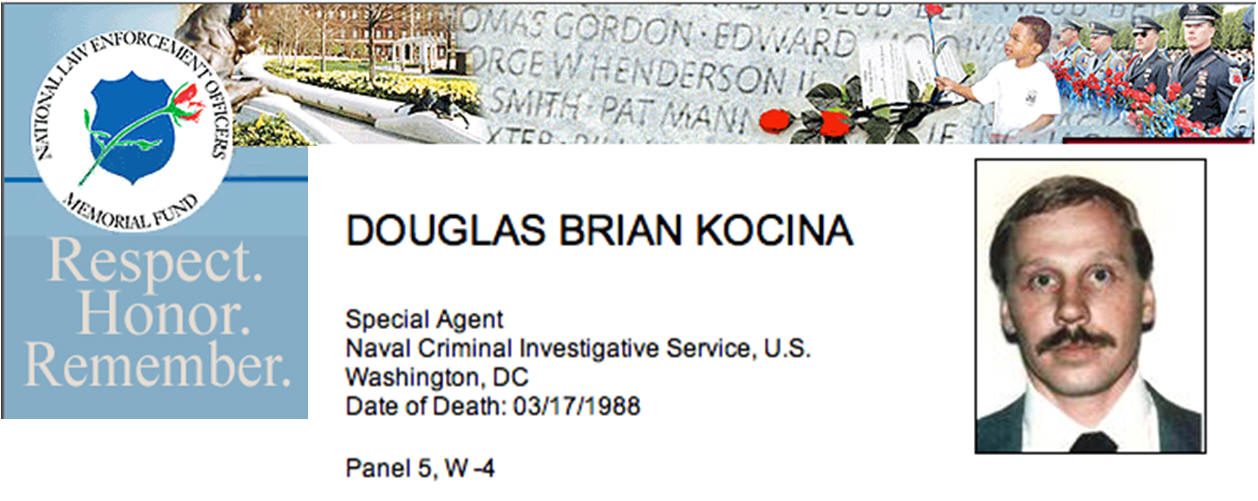
Kocina v. the Public Safety Officers Benefits Board
By Don Webb
Accident Analysis Service
In December of 1988,
Officer Tim Lytle, Medford Police Department asked me to review the Public
Safety Officers’ Benefits Act Claim regarding a former Medford Police Officer,
Doug Kocina who was killed in an automobile crash in Subic Bay the Philippines
earlier that year. The Public Safety Officers Benefits Board (PSOBB) in
Washington DC had ruled that his wife (Bette) and children were not entitled to
death benefits due to his gross negligence in the operation of a government car.
Day of the Accident:
On the day of the
accident Bette saw Doug’s commanding officer and the Chaplin pulling into her
driveway. She knew the worst had happened! However, she thought that Doug had
been assassinated by the NPA (New People’s Army). Doug had been working
under-cover intelligence on the NPA and she knew that the NPA were targeting Naval
Intelligence agents for assassination. She cried “where was he shot?” The
commander said “He was not shot. A bus crossed the center line and hit him
head-on. They (Doug and Jerry Kramer) both died instantly.
Investigation Report and
PSOBB Determination:
Mrs. Kocina was assured
by naval investigators that the bus was in the wrong lane and Doug was not at
fault. However, for whatever reason (local politics?), the investigation was
turned over to the National police. When the report came out, it blamed Kocina for
driving at a tremendously high rate of speed (132.7 kph - 82.5
mph) around a curve causing
his vehicle to cross the center line and hit the bus head-on. Then the PSOBB blamed Kocina for the accident
and relied heavily on the investigation report.
Bette Kocina wanted to
clear Doug’s name! “Doug was a dedicated
professional who died in the service of his county” she said. She could not believe that his country had
turned its back on him. Because of PSOBB’s determination, his spouse and
children were barred from receiving the $250,000 widow and orphan fund and Doug
Kocina’s name could not be put on the Public Safety Officer’s Memorial wall
commemorating police officers killed in the line-of-duty. She stated that what
was written in the PSOBB Determination was not true and anyone who knew Doug
knew it was not true!
Analysis of the Facts:
I took this case pro bono because of the miscarriage of
justice suffered by the Kocina family. My initial analysis of the
case and PSOBB Determination reveled that there were grave errors made by National
investigators and a rush by the US Government to agree with the local findings.
We had to go through the Freedom of Information
Act to have access to facts, reports and personnel. Most of the witnesses
were murdered or missing. The Navy personnel involved investigation were
scattered to the four winds. However, ultimately, we got the information we
needed for my Forensic Analysis.
Before examining my
analysis, the PSOBB Determination explains why they denied Doug Kocina his benefits.
PSOBB DETERMINATION
On March 17, 1988, Douglas
Kocina, a Criminal Investigator for the Navy Department was on duty and
stationed in the Philippines. He and his partner, Investigator Kramer were
returning to Subic Bay after completing foreign counterintelligence matters in
Bataan Province. Investigator Kocina, who was driving, passed another vehicle
on a curve while traveling at a high rate of speed. Their vehicle fishtailed
while rounding the curve and crashed head-on into an oncoming bus in the
opposing lane of traffic. Both men were killed in the accident. Investigator
Kocina's death was reportedly caused by massive head and chest trauma. Kocina's
spouse now applies for the award of benefits under the PSOB Act.
Section 3796 of the Act
provides in pertinent part that, "No benefit shall be paid...
(3) if the public safety
officer was performing
his duties in a grossly negligent manner at
the time of his death
Examination of the findings
of Navy investigators investigating the accident and of statements obtained
from eyewitnesses leads to the conclusion that Investigator Kocina was, in
fact, performing his duties in a grossly negligent manner.
In addition to the apparent
negligence on the part of Kocina, his reckless operation of the vehicle and
certain conduct engaged in prior to the accident indicate that Investigator
Kocina was also guilty of intentional misconduct in the performance of his duties
which may have contributed to his death. Section 3796a of the Act further
states that:
"No benefit shall be
paid...if the death was caused by the intentional misconduct of the Public
safety officer". Public Safety Officers' Benefits Act of 1976,
supra, at §3796a(1). In determining whether the officer's death was caused by
intentional misconduct, the Bureau must take into account, among other things,
whether the conduct was in violation of rules and regulations of the employer
and whether the misconduct was a "substantial factor" in the
officer's death. See, 28 C.F.R. §32.7.
Applying these factors to
the present case, it is clear that Kocina was guilty of intentional misconduct
in his reckless operation of the vehicle. An internal Navy policy statement,
establishing procedures for disciplinary action lists "violating traffic
regulations, reckless driving on Navy premises or improper operation of a motor
vehicle" as an offense punishable by reprimand or suspension for 2-10
days. As previously stated, the investigation report concluded that Kocina had
been negligent in operation of the vehicle which would have made him subject to
these disciplinary actions had he survived the accident. Moreover, the report
concluded that Kocina's negligent driving was the direct cause of his fatal
injuries which more than satisfies the "substantial factor" test in
our determination. Examination of these factors leads to the conclusion that
Kocina's intentional misconduct in his negligent operation of the vehicle
caused his death so as to preclude eligibility for benefits under the Act.
Further, the record
indicates that Kocina had consumed a considerable amount of alcohol while on
duty. In a June 14th letter from the Commander, Naval Security and
Investigative Command to the Judge Advocate General, additional findings of
fact were made in which it was disclosed that Kocina had consumed a 12 ounce
bottle of beer during each of his two counterintelligence related meetings
Although the investigative
report concluded that there was "no evidence that alcohol...attributed to
the accident", this determination falls short of concluding that the
consumption of beer was-not a "substantial factor" in Kocina's
ultimate death, because of the failure to conduct a toxicological examination
on the body to determine the actual level of intoxication. Notwithstanding the
investigator's determination, the amount of alcohol consumed and the close
proximity between the time of consumption and the accident raise strong
inferences that the consumption of beer was a "substantial factor" in
Kocina's death by impairing his judgment while in operation of the vehicle.
Investigator Kocina' s gross 'negligence in operating the vehicle and his
intentional misconduct in failing to properly operate the vehicle and in
consuming alcohol while on duty in violation of Navy policy necessitates a
finding of ineligibility for receipt of benefits under the Public Safety
Officers' Benefits Act.
END OF
DETERMINATION
Not
mentioned in the findings was the threat against NIS Special Agents lives by
the New People’s Army (NPA) and the fact that the high tension existed for the
personnel and families in the area. No mention was made that Doug had just
attended a four day Anti-terrorist Driver Course and completed it the day
before the accident. The course curriculum included evasive actions to take in
a kidnapping or assassination attempt. One of the scenarios covered in the
course was the use of a ‘Jeepney’ in an assassination attempt. A Jeepney is a
World War II jeep that has been converted for civilian use. Thousands of these
jeeps were left behind after the war and the civilians have converted them for
their personal use. The NPA had used a Jeepney armed with a machine gun to
assassinate locals. The MO was to suddenly pull out from a side street in front
of the victim’s car and machinegun him. Doug’s training included the evasive
action to veer to the left and accelerate hard away from the area (which was
actually what he did).
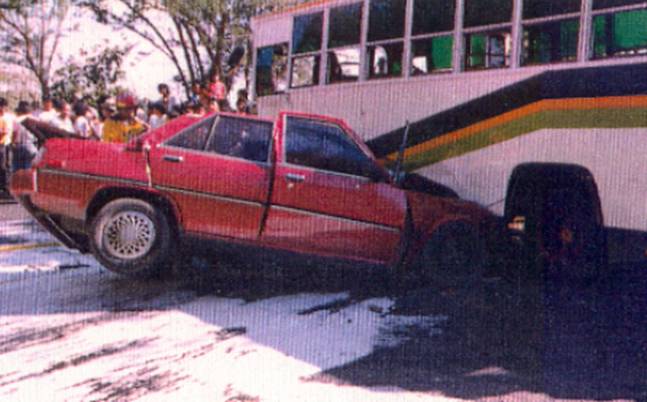
Alcohol Consumption:
The first witness (who by the way had been murdered by the time we
tried to find him) stated that he saw a Jeepney pull out in front of Kocina’s vehicle
and observed the vehicle veered to the left and accelerated at a high rate of
speed. He did not see the actual accident, but heard it. He could not tell what
lane the vehicle was in because it was around the curve when the impact
occurred.
Intelligence
Assignment:
Doug
and his partner were working with a confidential intelligence source (not
available for our interview). They left Subic Bay at 08:00 and traveled
directly to Hermosa, Bataan for a 10:00 Meeting. Subsequently, they went to the
confidential intelligence source’s home where they had lunch and a beer (12
ounces). Next they met with another confidential source (not available
for our interview) at a restaurant around noon where they each had another 12
ounce bottle of beer. Approximately 3 hours had transpired from the first beer
to the accident and 45 minutes from the second beer to the accident. Both were
consumed while eating lunch or snacks.
There
was a written policy that prohibited on-duty agents from consuming. However,
there was an unwritten policy for undercover agents that allowed them to drink
with their sources. It was an insult not to drink when offered a drink. Agents
would usually not drink the entire beer but would ‘nurse’ it. There were no
witnesses that saw the agents finish drinking the beers. The Navy did not
perform an autopsy. Thus, there was no forensic evidence as to the level of
alcohol in the blood stream.
Investigator’s
Credentials:
The
government placed a lot of value on the National investigator’s speed
calculation. The investigator was a ‘National’ with the following traffic
accident credentials:
Experience 3 years
Basic Training 140 hours
Accident Reconstruction Training 40 hours
Breathalyzer Testing
4 hours
Directing Traffic 4 hours
Speed
Calculation:
The
‘National’ investigator used the Critical
Speed formula to determine the speed of the Kocina vehicle. He could not
find any scuffmarks but used the final rest position of the bus and the bus driver’s
statement to locate Kocina’s travel line. The bus driver stated that he
observed coming at him in his lane and he pulled over (right) to the guardrail
and stopped and then the vehicle hit him. He estimated its speed at 140
kph (86 mph).
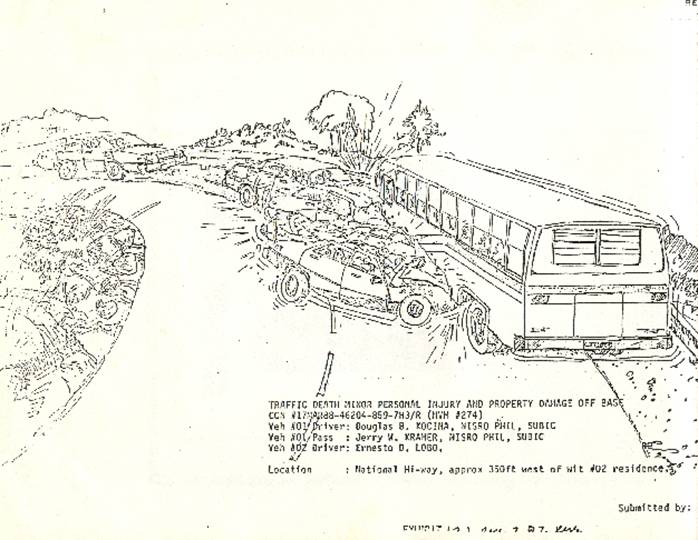
Investigator’s Accident Diagram
The
investigator determined the radius of the center line (240 meters) for the
travel path of the Kocina vehicle and came up with a speed of 132.7 kph (82.5
mph). The government was not forthcoming with our request for documents,
photographs and Special Agents statements. The agents at the scene had to be
tracked down. When located, they were eager to cooperate with our investigation
and gave testimony at the hearing. One of the Agents sent us his own
photographs showing a gouge mark and scuff mark leading from the center
line to Point of Rest was clearly visible. In fact, there was a photo of two
investigators standing near these marks as if to examine them. Based upon the
location of the Point of Rest and the Point of Rest, I was able to determine
the speed at impact to be approximately 40 to 50 mph for Kocina and
approximately 25 mph for the bus. I was also able to determine that the
accident would have occurred even if Kocina’s speed was 35 mph – the speed
limit.
Notice
the person in the photograph below is directing traffic and armed with an AK
47. This is not a normal accident scene! At the time that this photo was taken,
it was thought that the NPA had assassinated the agents.
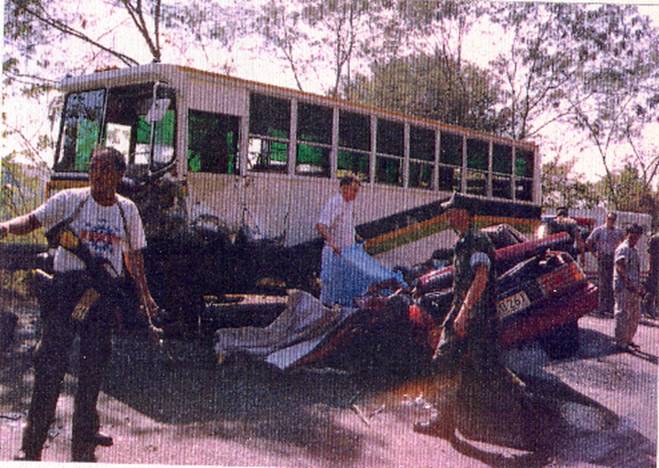
The
photograph below is one of the photos that I used in my testimony. The mark on
the roadway that is circled (lower left) is a scuff mark make by the right
front tire at impact. I used this to prove that the bus was in motion and not
stopped at impact. I used another photograph that depicted the gouge mark
and scuff mark and the marks on the roadway leading toward POR. When the left
front tire of the bus is placed on the POI left scuff mark (not shown here),
the left corner of the bus is 12 to 18 inches in the opposing lane at impact.
The rear of the bus is in the middle of Kocina’s lane. When Kocina first
observed the bus, he had no time to take any evasive action
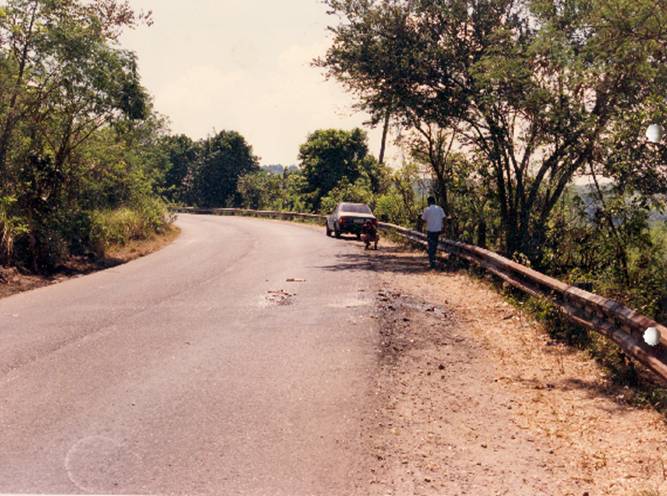
The
bus driver stated that he had stopped to pickup a passenger just before the
accident. It is common for busses to cross to the other side of the roadway to
pickup a passenger. However, this was never followed up on and the bus driver
and his brother (also on the bus) had disappeared by the time we got involved
in the case.
On
September 19, 1990, I testified in the Appeal Hearing. The final Determination:
PSOBB FINAL DETERMINATION
Background
This determination resulted
from an appeal of the original Public Safety Officer's Benefits Program finding
that the death of Douglas B. Kocina, a Criminal Investigator with the U.S.
Naval Security and Investigative Command, was not covered under the provisions
of Section 609F of the Justice Assistance Act of 1984 (4~ U.S.C. 3796), 28
C.F.R. 32.1, et seq., as amended (Public Law 94-430, as amended by Public Law
98-473 and Public Law 99-591). Specifically, the Act, as set out in 28 C.F.R.
32.6(a)(3), prohibits the payment of benefits if a public safety officer was
performing his duties in a grossly negligent manner at the time of his death.
The original denial was
based upon an investigation of the accident by the Navy, which came to the
conclusion that Agent Kocina "endangered his life and his passenger Jerry
W. Kramer through reckless imprudence. His unsafe operation of a government
vehicle by excessive speed and poor judgment is the cause of this
accident." It was alleged that Agent Kocina, who was driving, passed another
vehicle on a curve while traveling at a high rate of speed and crashed into an
oncoming bus in the opposing lane of traffic.
By letter received October
31, 1988, Mrs. Bette L. Kocina requested an appeal hearing because she believed
that the original decision to deny benefits was not based upon accurate
testimony and evidence and that the findings inferred fault upon her husband
which she believed to be unjustified.
Hearing
On September 19, 1990, an
appeal hearing was held in Medford, Oregon in order for the wife of the
decedent, Mrs. Bette L. Kocina, to present any evidence or testimony which
could lead to a reconsideration of the original finding to deny benefits.
At the hearing, the claimant
presented evidence and testimony directed toward the contention that the
investigation of the fatal accident conducted by the Navy was flawed in its
conclusion that Agent Kocina operated his vehicle in an unsafe and reckless
manner and that the accident was actually caused by the bus traveling in the
wrong lane which collided with the vehicle driven by Agent Kocina. The
following is a summarization of the relevant testimony and documentation
presented during the appeal process:
Use of Alcohol
On the day of his death, Mr.
Kocina and Mr. Kramer had two meetings with informants. At each of the
meetings, Mr. Kocina consumed a 12 oz. bottle of beer and ate lunch at one
meeting and snacks at the other. The interval between the consumption of the
beer and the fatal accident was approximately three hours. Although the Naval
Investigative report states "That there is no evidence that alcohol or
other chemical substance attributed to the accident," the Office of
General Counsel, Office of Justice Programs (OJP), suggests that the
consumption of alcohol may have been a substantial factor in Mr. Kocina's
death.
At the hearing, the
following testimony was given relating to the use of alcohol by investigators
while conducting counterintelligence interviews with informants, Mr. Kocina's
personal usage of alcohol, and the effects of the consumption of two bottles of
beer over a three-hour period:
(1) Police Officer Timothy
Lytle (Pages 7 - 18). In response to the question of whether the drinking of
two beers over a period of two or three hours would have affected Agent
Kocina's judgment, Officer Lytle stated:
". . . Alcohol
dissipates at a standard rate of one beer, one glass of wine, one shot of
whiskey with an average sized individual who is physically healthy, et cetera,
at about, one unit per hour. If you had two beers over the span of three hours,
it would be a negligible response in a breathalyzer or chemical test."
(2) Special Agent John
Richard Moreschi, Exhibit No.4, Affidavit and Testimony (Pages 18 - 53).
Special Agent Moreschi was assigned to the counterintelligence unit in the
Philippines and helped train Agent Kocina. He testified in the affidavit as
follows:
"Much of the
information collected about security threats came from ' sources' who were
Philippine nationals. NIS agents would meet with sources and obtain whatever
data possible about security threats. These meetings would also involve the
consumption of food and alcohol. It was important to the source that the NIS agent
shares in his consumption. In the Philippine culture, it was a big insult to a
source if you refused to drink a beer with him/her, or refused food that was
offered.
NIS silently condoned the
use of alcohol when meeting with a source. In the Phl1lippines, NIS spent
thousands of dollars a year on alcohol. Funds expended on sources were recorded
via a voucher system (C/CI) and the source was identified by a number on the
voucher. CICI is the Criminal and Counterintelligence fund utilized by NIS.
Doug Kocina and I met
sources several times together. During these meetings, I would notice that Doug
would just 'nurse' his beer for appearances sake and would consume very
little alcohol. Because of the threat of the Communist New People’s Army (NPA),
most of the meetings with the sources were dangerous. Doug was very
conscientious about his work and was always aware of his surroundings and in
control. Doug was also, a physical training fanatic and I believe that is
another reason he didn't drink much alcohol."
Special Agent Morechi's
direct testimony (pages 19 - 53) amplifies and expands his testimony given in
his affidavit.
(3) Special Agent Robert
McSherry, Affidavit (Exhibit 6), Testimony (Pages 53 - 81). Mr. McSherry in his
testimony and affidavit corroborates the statements of Special Agent Morechi's
concerning the use of alcohol by counterintelligence agents in the Philippines
when dealing with informants (sources).
(4) Special Agent Thomas J.
Goodman, Affidavit (Exhibit 7). Mr. Goodman corroborates the statements of
Special Agent Morechi's concerning the use of alcohol by counterintelligence
agents in the Philippines when dealing with informant (sources).
(5) Lieutenant Gary Knowles,
Director of the Oregon State Crime Detection Lab, testified in an affidavit
(Exhibit 13) that, based upon the facts ~ presented in the Naval Investigation
report, the alcohol content remaining in Agent Kocina's body at the time of the
accident would have been at a minimal level or approximately .02%.
Driving hazards in the
Philippines
Agents John Moreschi
(Testimony, pages 36-41, Exhibit 4, Affidavit), Robert J. McSherry (Testimony,
pages 68-74, Exhibit 6, Affidavit), and Thomas J. Goodman (Exhibit 7,
Affidavit) testified to the conditions of the Philippine roads and the driving
habits of the Filipino drivers. The roads have been described by these
witnesses as probably the worst roads I have ever seen in my life! I couldn't
do it justice by describing it, you know. I really and truly believe that you
can't comprehend, cannot truly comprehend how unsafe they are unless you have
been there, and one must also consider the road conditions in the Philippines
when evaluating the cause of this accident. Cars are not maintained so there
are oil slicks on Filipino roads . . . . I have driven vehicles in Europe,
Asia, the Middle East and other places in the world, and the Philippines have
the worst driving conditions.
With respect to the driving
habits of Filipino drivers these same witnesses testified that:
I can recall driving down,
the National Highway and having a bus traveling at a high rate of speed
approach in either direction, I mean it wasn't unusual for them to come into
the other lane, you know, maybe to pass a passenger Jeepney, a peasant in a
caribou cart or a trike, absolutely horrifying to drive down these roads.
Driving conditions are unsafe in the 'rules of the road' are not adhered to by
Philippine drivers. It is common for bus drivers to drive in the wrong lane of
traffic when driving around a curve. Drivers have no concern for other
Vehicles.
Perhaps the most descriptive
evidence concerning Mr. Kocina's driving abilities and the driving habits of
the Filipinos can be found in the affidavit of Gerold O. Smith (Exhibit 8) who
taught the course "Evasive Driving/Counterintelligence Training"
which the deceased completed the day before his death. With respect to Mr.
Kocina, Mr. Smith states that:
". . . I rode along
with Doug Kocina all of one day of the class during the 'street exercises.' He
was chosen by 'his peers as the team leader for these exercises. I was
impressed by Mr. Kocina as I found him to be very serious about the class. He
was sharp and appeared to put all of his personal effort into this study.
Moreover, his driving skills during the class were excellent."
In September 1989, Mr. Smith
returned to Subic Bay, Philippines and observed the curve where Mr. Kocina had
his fatal accident. Mr. Smith states:
"We stopped near the
curve and I took a photograph of it. The slide of the curve has been placed in
an envelope attached to this affidavit, and depicts the direction from which
Mr. Kocina was traveling. I was facing in the same direction as the bus
traveling into the curve that struck Mr. Kocina's vehicle. Mr. Kocina's vehicle
would have been traveling up a hill while proceeding into the curve. The
centerline of the roadway, if it ever existed, has been worn off.
While observing the traffic
at this curve, I noticed busses and trucks driving well over the center line as
they made the left hand curve and headed down the hill. There were no center
line markers and since the vehicles coming down the hill are moving very fast,
they often 'cheat' and move over into the oncoming lane to flatten or increase
the radius of the corner. This is the theory of high speed driving in corners
used by racers. The problem of doing this on a public road is obvious. When the
curve is to the left as is was for the bus that struck Mr. Kocina's car, the
apex of the curve will be in the oncoming lane if the driver 'cheats,' whereas
just the opposite is true for right hand turns. I cannot imagine that Mr.
Kocina would have driven into the oncoming lane knowing how the buses and
trucks drive into the oncoming lane on curves such as this one. We observed
buses and trucks 'cheating' on just about every downhill curve through which we
traveled."
Technical Evaluation of
the Accident
Captain Donald Webb testified
(pages 109-160) and presented a Fatal Motor Vehicle Accident Reconstruction
Report (Exhibit 21) in which he reconstructed the accident which took the lives
of Agents Kramer and Kocina. Captain Webb is currently employed by the Oregon
Board on Police Standards and Training, is a consultant to the Polk County
District Attorney for fatal accident investigations, and maintains his own
business of analyzing and reconstructing accidents. His education, specialized
training, expert testimony, and published material in the area of vehicular
accident reconstruction represented an opportunity to observe the
reconstruction through a second party. It should be pointed out at this
juncture that Captain Webb utilized the same documents and evidence which were used
by the naval investigator. These documents were secured through the Freedom of
Information Act.
From a reading of his
testimony and report, various flaws in the naval investigation came to light.
Perhaps the most critical piece of evidence which was overlooked was the
existence of scuff marks on the road left by the bus. The marks are clearly
visible in a naval investigative photograph (Exhibit 24) and serve to locate
the left front wheel of the bus on the center line of the road, with the bumper
in Mr. Kocina's lane of travel. Captains Webb's opinions with respect to the
reconstruction of the accident are as follows:
1. The point of impact
occurred in the east bound lane of travel (KOCINA'S) not in the west bound
lane.
2. The speed of the KOCINA
vehicle at impact ranged from 40 to 50 Miles/hour.
3. The closing speed of the
vehicles ranged from 65 to 78 miles/hour (95 to 114 feet/second).
4. The total distance that
the vehicles traveled while closing ranged from 142 to 171 feet given an
average perception/reaction time of 1.5 seconds.
5. The sight distance
involved in the accident prevented either driver from taking evasive action.
6. At 35 miles/hour for
KOCINA, the accident would still have occurred.
7. The passing of the Jeepney
did not contribute to the accident.
8. The primary cause of the
accident was the mini-bus's occupation of the wrong lane just prior to and at
the time of impact.
9. The sightline for both drivers
would be reduced with the mini-bus in the wrong lane of travel.
Exhibit 34 is a graphic
depiction of the accident prepared by Captain Webb based upon his
reconstruction of the accident.
Determination
Based upon the testimony and
the evidence presented, I find that the investigation conducted by the Navy
into the cause of the fatal accident which took Mr. Kocina's life was flawed in
many areas, but primarily in its conclusion that Agent Kocina's death was cause
by negligence and misconduct in the operation of his motor vehicle. To the
contrary, I believe that evidence and testimony presented at the hearing, with
particular emphasis on the reconstruction of the accident by Captain Webb,
clearly shows that Agent Kocina was operating his vehicle in a safe manner when
his car collided with a bus which was on his side of the roadway. Therefore,
since Agent Kocina was on duty and was fatally injured in the performance of
his duty as required by the Act, I reverse the original finding and rule that
his survivors are entitled to the benefit to be paid.
CONCLUSION
On May 10, 1991, Bette Kocina
was present at the Police Officer Memorial in Washington DC to hear her
husband’s name, Douglas Brain Kocina read and placed on the Memorial
Wall (Panel 5, W-4).